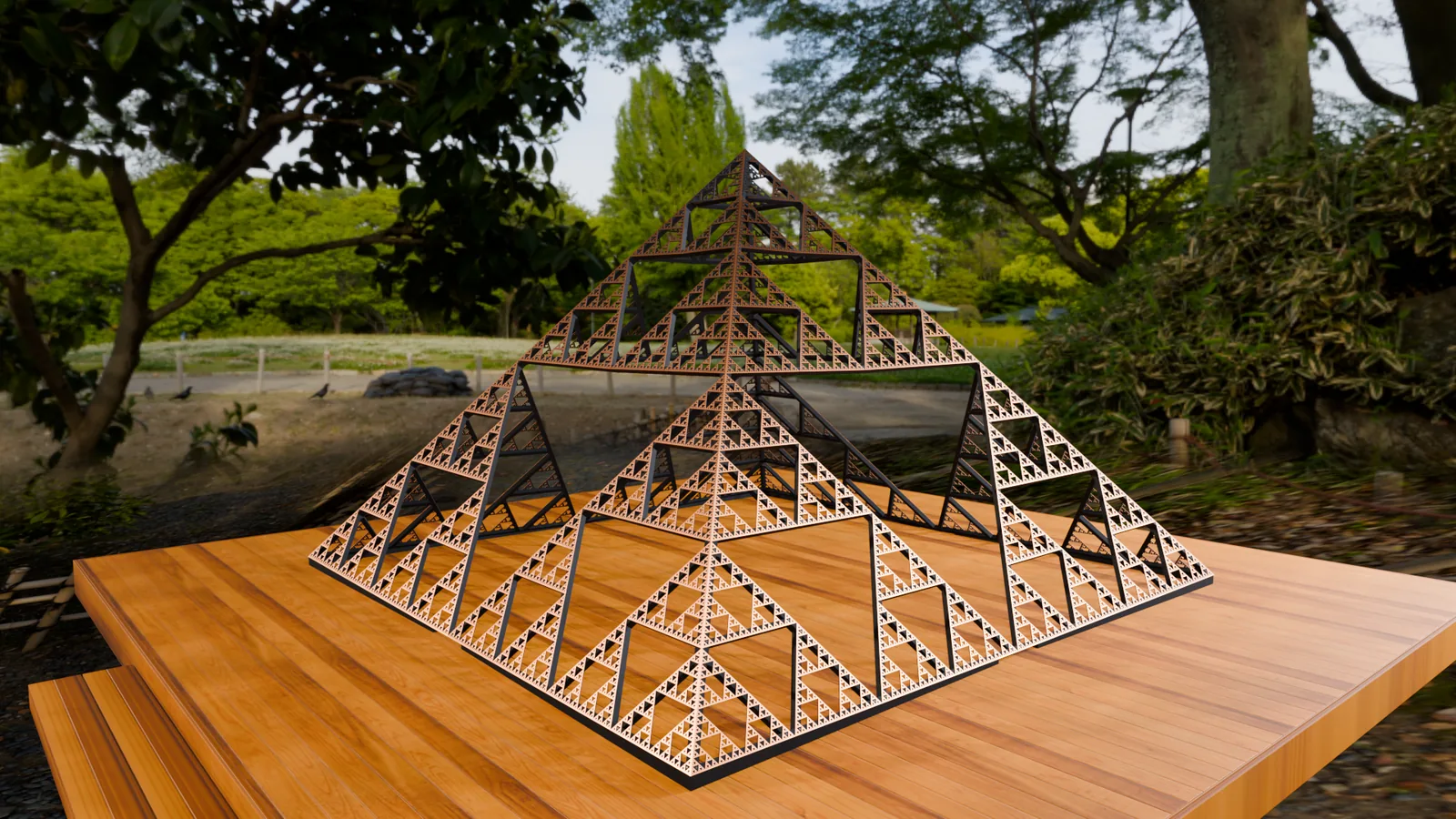
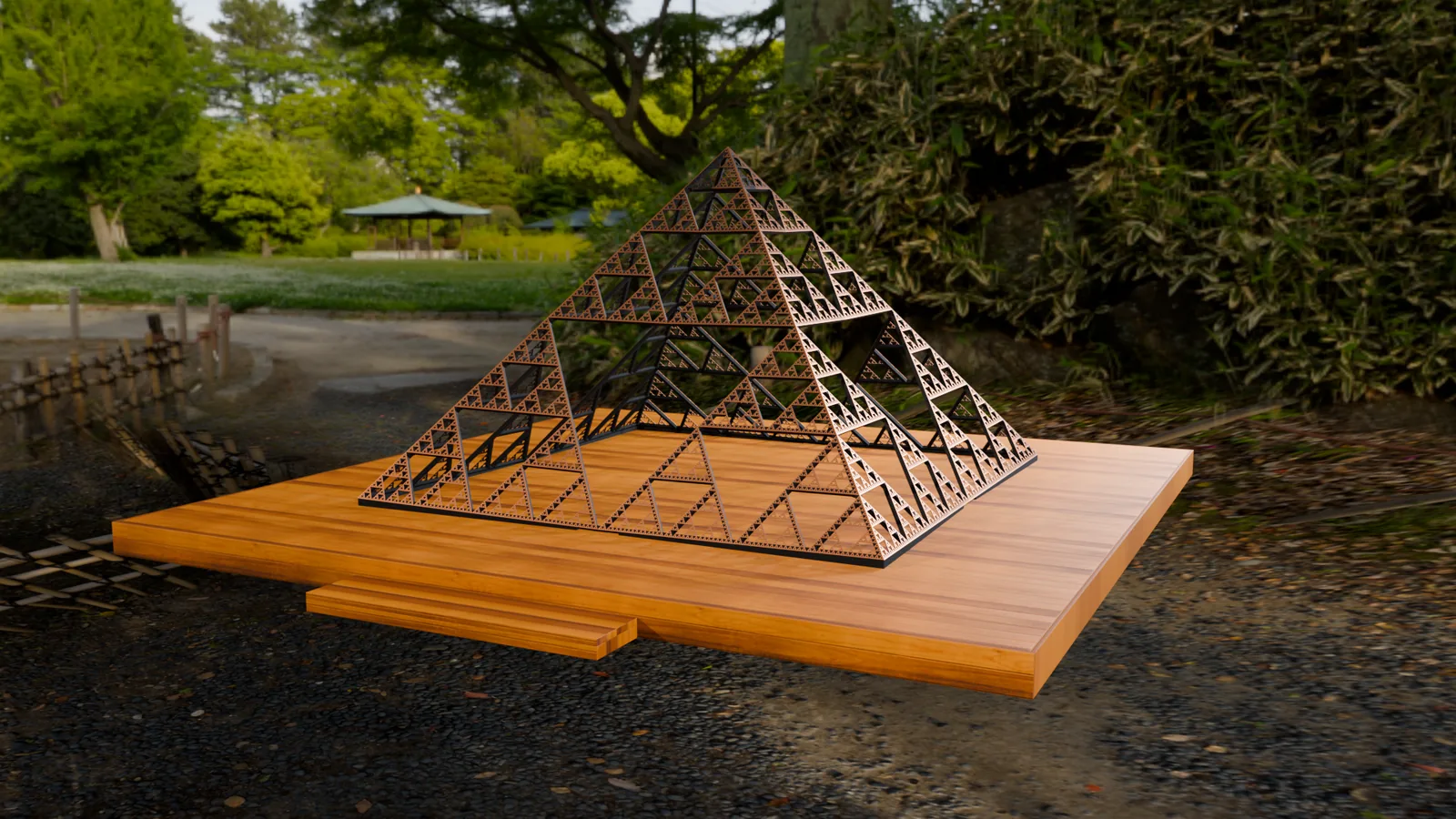
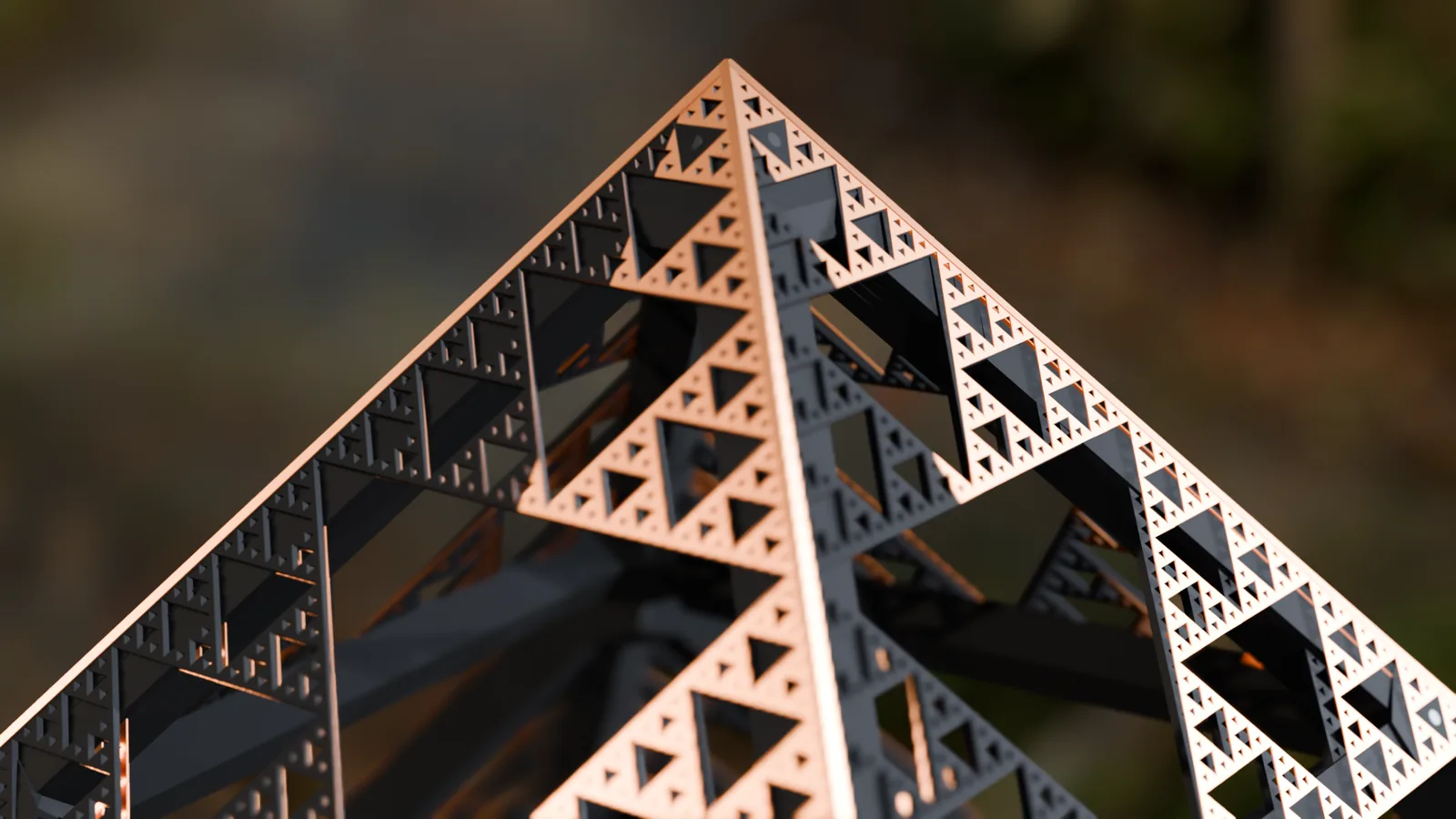
Giza's exact proportions, its eight facets, conductive copper and Sierpinski fractals. The fractal amplifies the geometry, so the Great Pyramid can work at the scale of one person sitting inside.
The Great Pyramid lenses and focuses energy through its proportions. Copper conducts it, and the fractal repeats the same triangle at every scale, so the geometry is still fully present when the whole shrinks to 1.8 metres.
GIZA 29.98° N · 31.13° E → 1 : 81
Designed by Krasimir Kolev · Guidance from Bashar
1.80 mHeight · sit inside
π / 2Base ÷ height, as at Giza
51.85°Face slope
8Facets · φ² fold
9Fractal levels
108Identical copper panels
0Metal parts except copper
// 01 — The geometry
Giza's proportions, carried by a fractal.
The Great Pyramid is 280 royal cubits tall and 440 wide. Height to base is 14 to 22, and since 22/7 is the ancient value of π, the base is π/2 times the height. The faces rise at 51.84°, and the slope height divided by half the base is the golden ratio φ. Our pyramid keeps exactly this proportion: base 2,827 mm, height 1,800 mm.
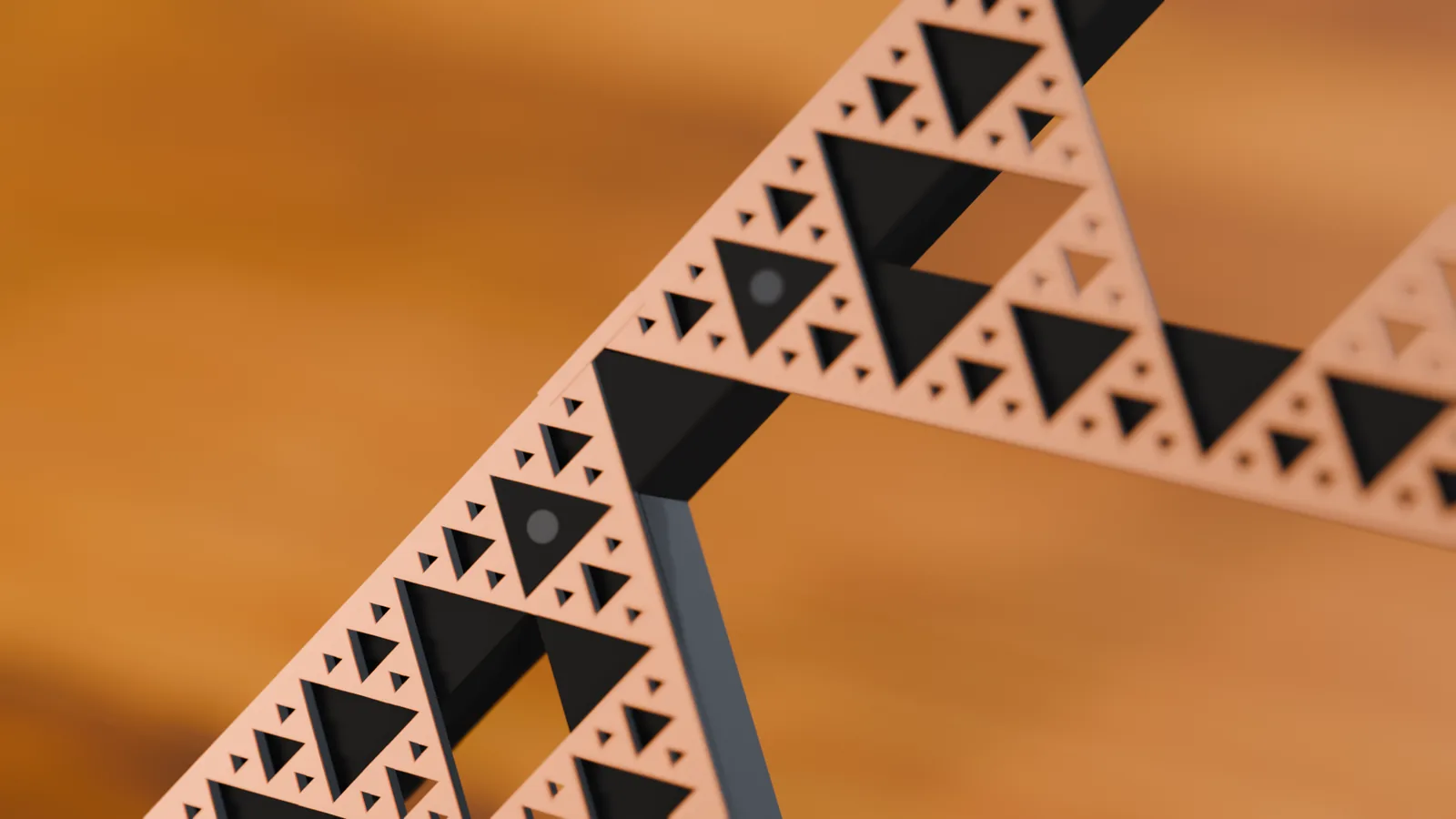
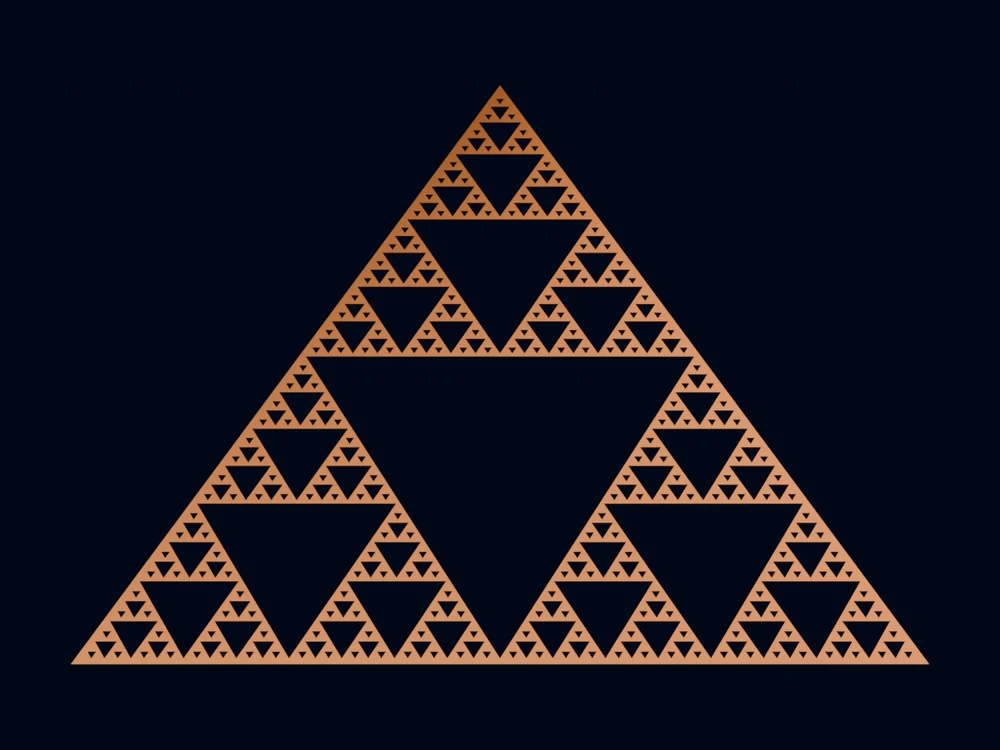
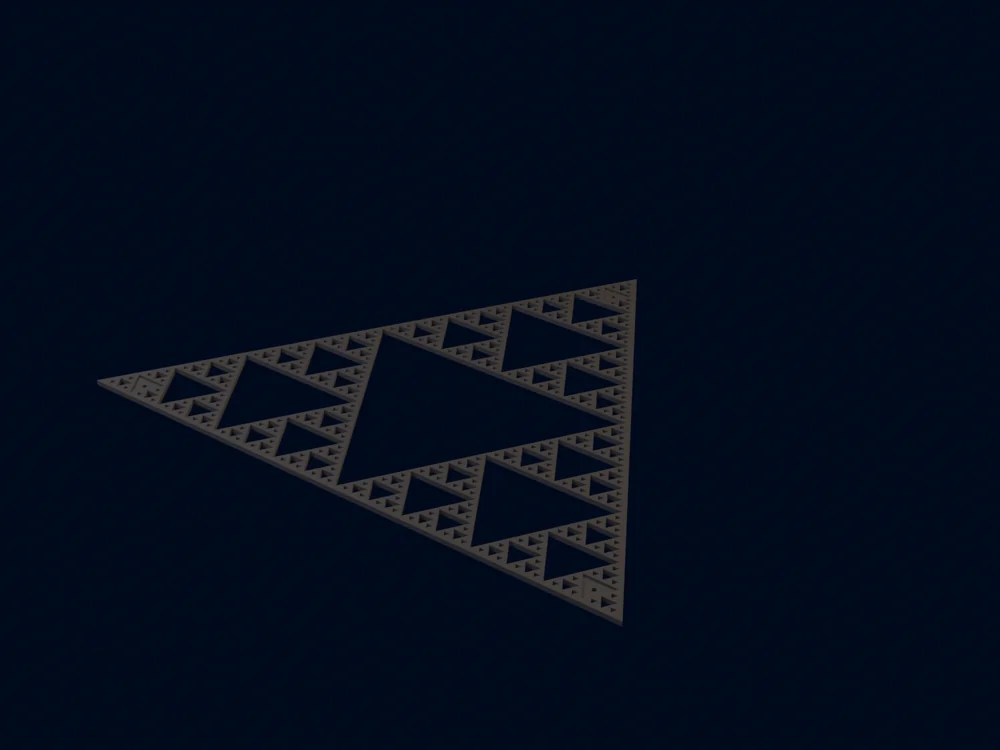
Each face is a Sierpinski triangle: the face is divided into 27 identical copper panels (three levels), and every panel is cut six more levels deep: nine fractal levels in total. The same triangle repeats from 2.8 metres down to about 5.5 millimetres. That self-similarity is what lets the small structure hold the whole geometry.
Three levels of panels per face, each panel six levels deep: nine levels in total. Bashar asked for at least three, and confirmed six.
Eight facets, not four
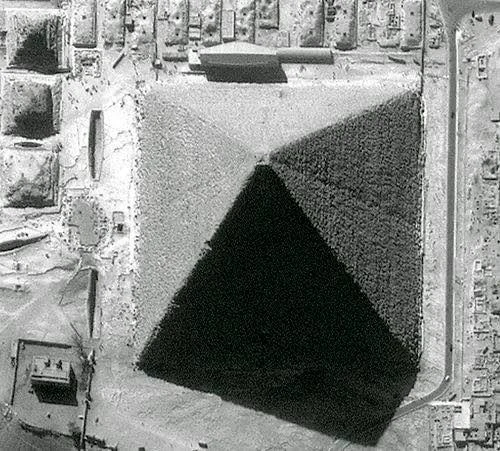
The Great Pyramid is not a simple four-sided pyramid. Each face bends in very slightly along its centre line, so the four faces are really eight facets. In the right light at Giza you can see the line down the middle of each side. Bashar described this to us directly (see the session below): bend the sides the same way, as long as the proportions are accurate.
The Great Pyramid from above, in low sun: each face splits into two facets along its centre line. Aerial photograph, often attributed to the 1940 survey flight by P. Groves (RAF).
How deep is the fold at Giza? Flinders Petrie measured the hollowing in 1883 at about 37 inches (0.94 m) in the middle of a face, roughly 0.94° in total. The figure is debated: the smooth white limestone casing that once covered the pyramid has been removed, so today we measure the rough core, and nobody knows how concave the finished faces were. Some researchers think the creases are partly the result of later damage.
Why φ² for ours. At 1.8 metres, a fold of under one degree would be almost impossible to build and to see. We chose φ² = 2.618° deliberately: still very gentle, 1.309° for each half-face, but clearly concave, and tied to the golden ratio that already governs the pyramid's slope.
Drag the slider to fold the faces and watch what happens to the base. Compare with the Giza value.
Plan view · from above
One face · side view
Drawn at true scale: this is how slight the fold really is.
2.618°
32.3 mmEdge middle moves in
24.0 mmCorners lift
+0.7 mmApex rises
sameAll 108 panels
The numbers are always real, from the rigid-fold solution for identical, unbent panels: 32 mm on a 2,827 mm base edge is 1.1%, and a 24 mm lift on a 1.8 m pyramid is about a finger's width. "Giza ≈ 0.94°" is Petrie's 1883 measurement of the core (about 0.47° per half-face); the original cased value is unknown.
// 02 — The engineering challenge
Identical panels, a folded shape.
The hardest part was keeping all 108 copper panels identical while the faces fold. A rigid, identical panel cannot stretch, so when the faces bend inward the geometry answers elsewhere: every base edge becomes a shallow V. The middle of each edge touches the ground, the four corners lift about 25 mm, and seen from above each edge bows about 32 mm inward.
The first design stood on a flat 20 × 20 mm base ring. With the fold, that ring no longer fitted, and keeping it would have meant cutting the bottom tubes lengthwise. So the ring was removed completely, and the base was redesigned around the V.
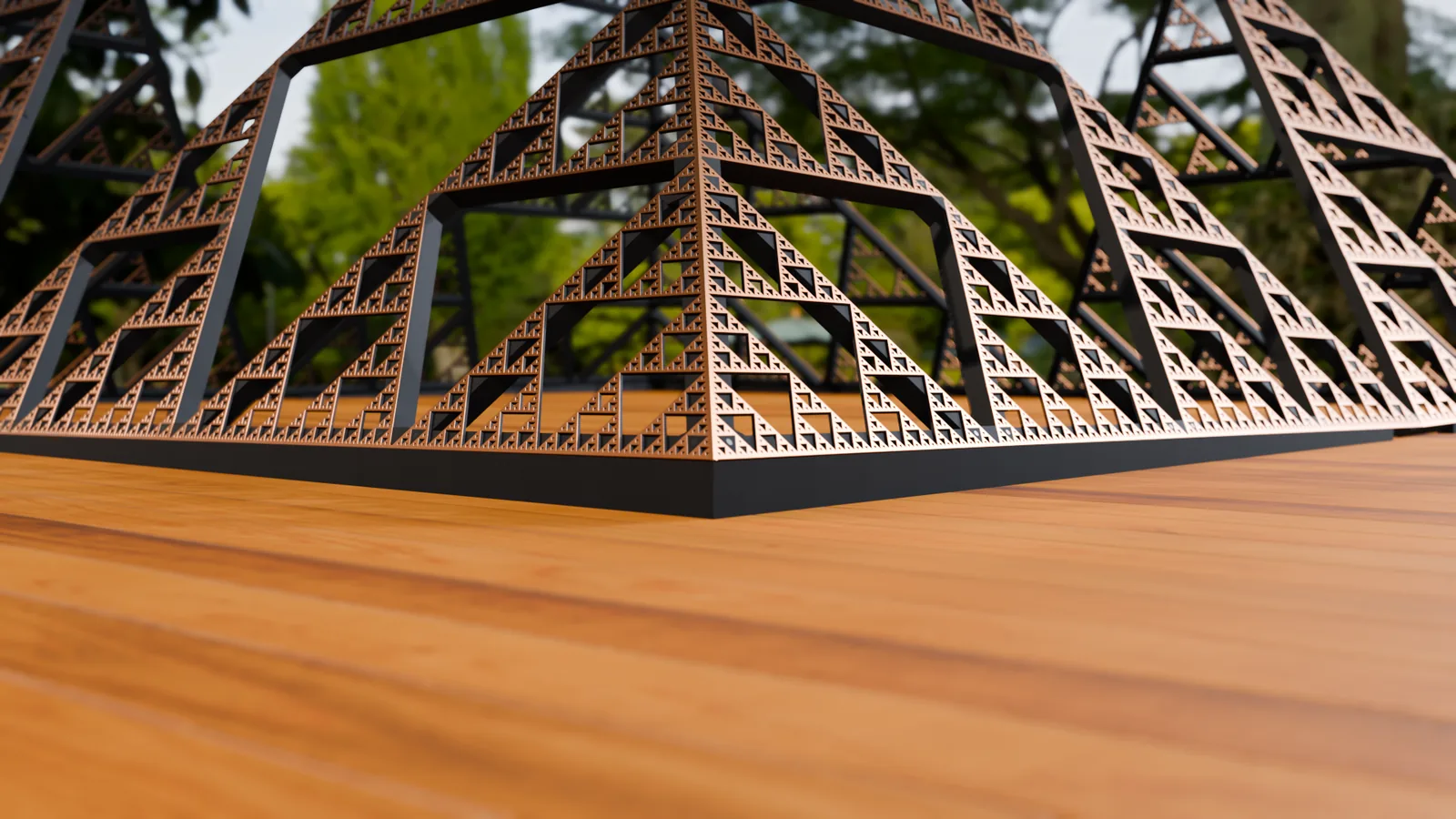
The black V-cradles along a base edge. No gap shows anywhere under the pyramid.
32 V-cradles
The bottom tube's corner sits in a V, cradled on both sides, so the pyramid centres itself and cannot slide.
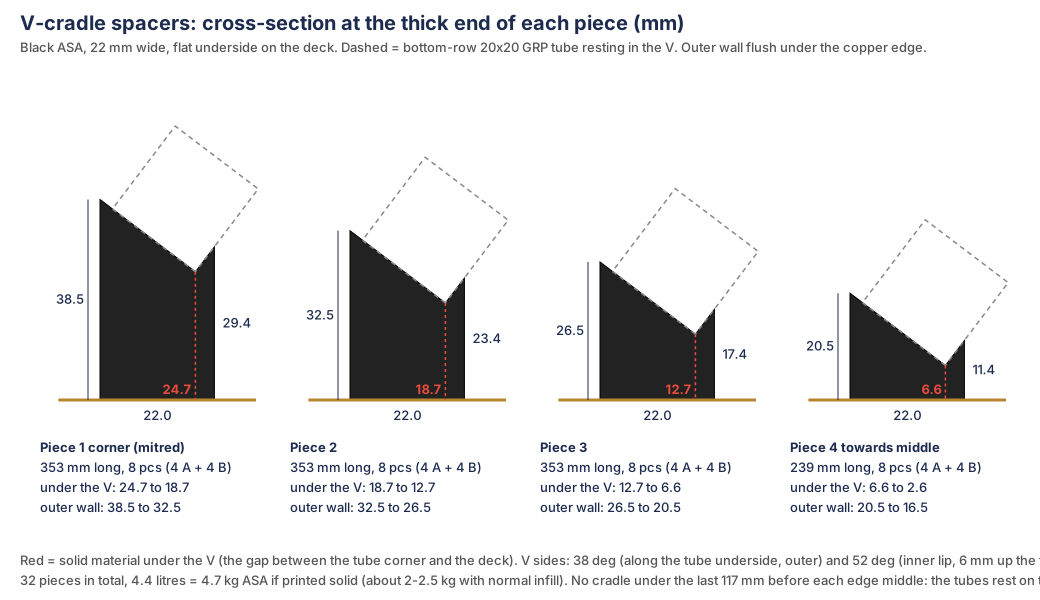
Tapered with the fold: from about 25 mm under the tube at each corner down to about 3 mm near the edge middle, where the pyramid rests directly on the floor.
Printed in black ASA, four piece shapes, 353 mm long, one under each run of tube between two joints.
// 03 — Layers of the build
Four layers, no glue, no metal screws.
Copper
Thin copper sheet cut with the Sierpinski pattern, the active surface. Bashar: no thicker than 1/16 inch (1.6 mm).
Black printed layer
3 mm ASA with the same fractal, so every hole goes right through. It carries the copper and seats the flush clamps.
Fibreglass frame
20 × 20 mm GRP tubes under every panel edge, non-conductive and light. The hip tubes turn corner-up under the ridges.
Printed connectors
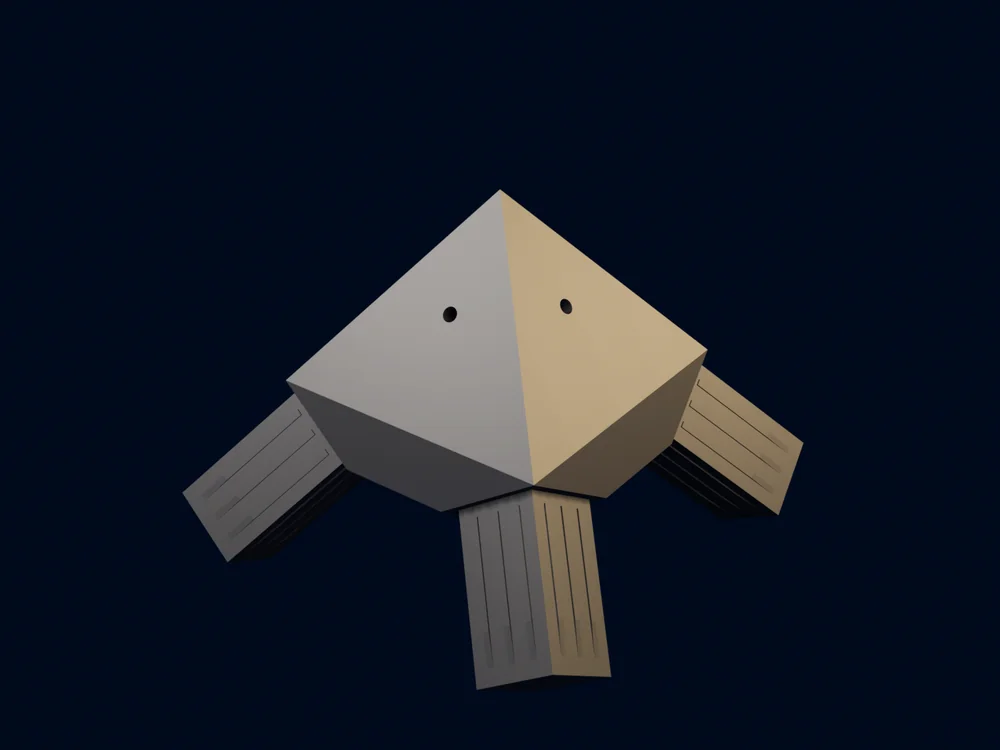
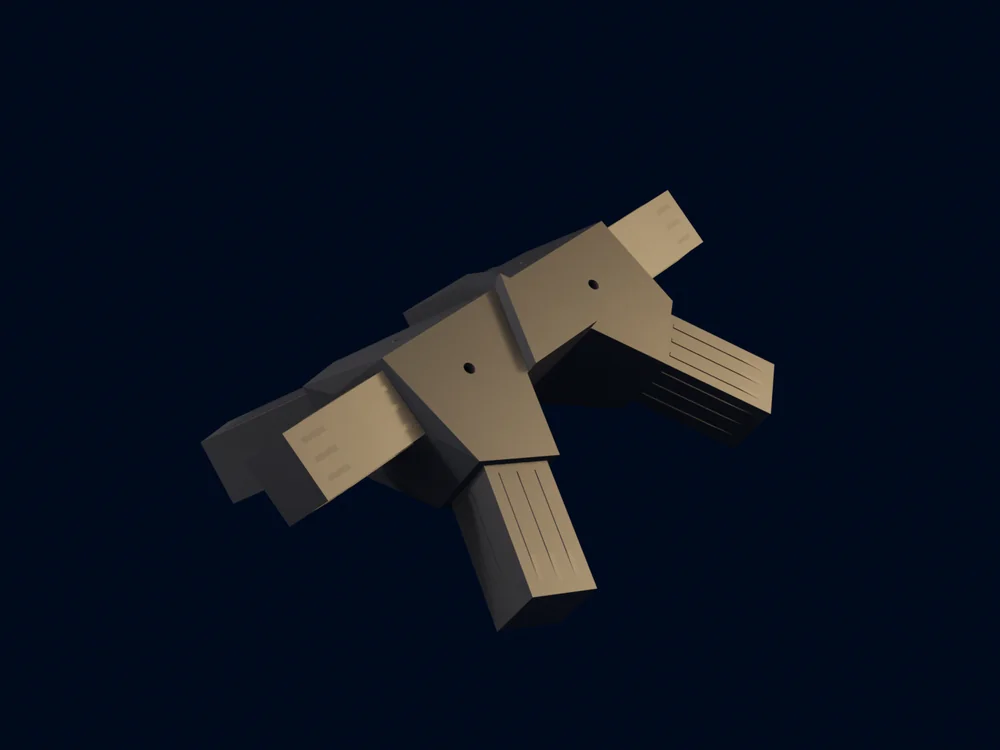
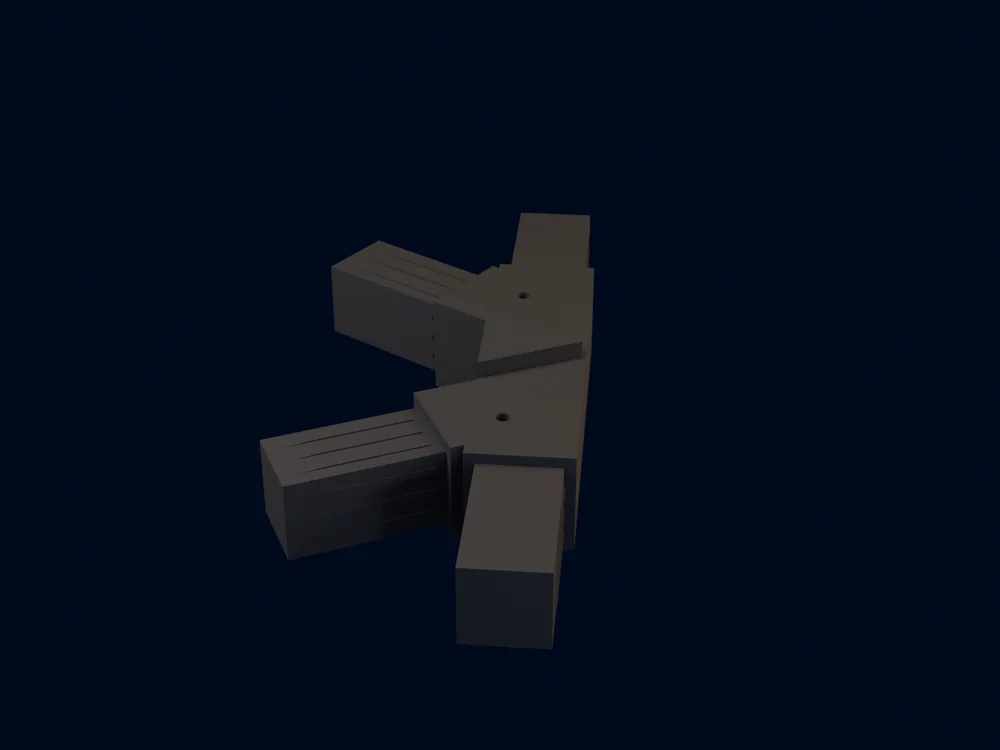
133 joints in black ASA. Spigots with crush ribs press into the tubes, and alignment keys locate every panel tip.
Copper on its black layer, with the flush clamps at the panel corners.
Self-aligning: every joint has an alignment key that fills the gap between two panel tips, with 0.4 mm clearance, so a panel can only sit one way.
Press-fit, no glue: each connector arm has a 30 mm spigot with three crush ribs on every face that grip the tube.
Nylon only: 324 clamps held by M2.5 nylon screws into nylon nuts captured in hex pockets. Copper is the only metal in the whole pyramid.
Every part, up close
01 / 10
Copper Sierpinski panel
× 108 · all identical
The active surface: 0.5 mm copper sheet, laser-cut with six levels of the Sierpinski gasket. 27 panels make one face, adding three more levels: nine in total.
353 mm base, sharp corners, about 5.5 mm smallest hole
Three clamp corners hold it flush on the black layer
02 / 10
Apex connector
× 1
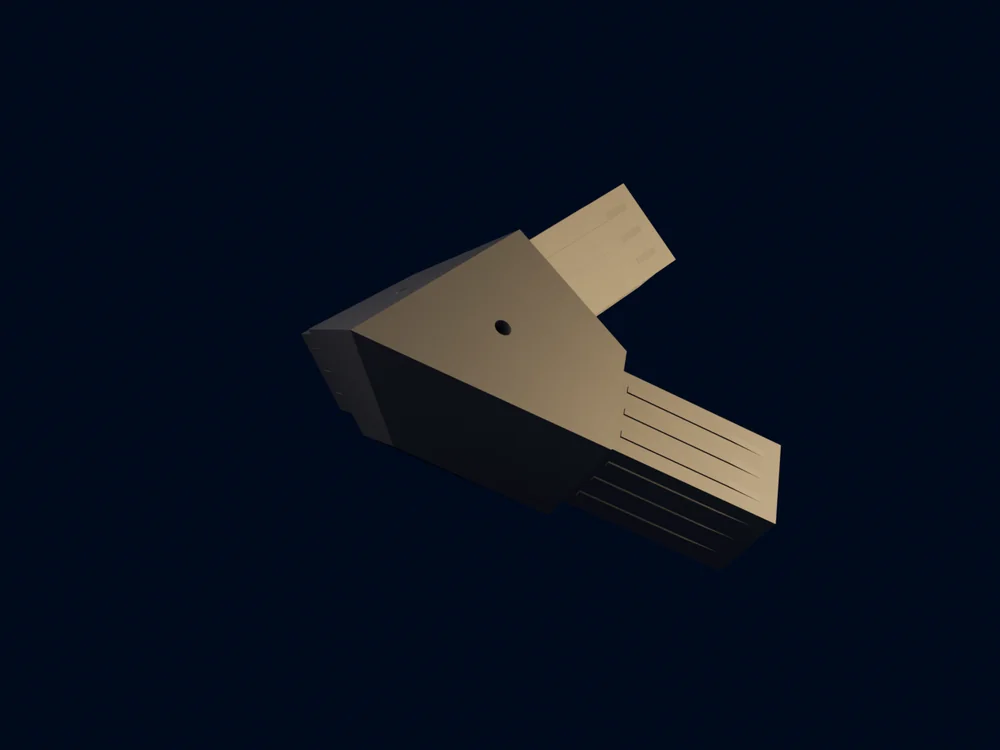
The top of the pyramid. The four hip tubes plug in from below, and the four apex panels are clamped onto its sloped faces.
Hip tubes start 55 mm out, clear of each other
Clamp screws land in solid printed material
03 / 10
Hip joint
× 28
Sits on the four corner ridges. The hip tube, turned 45° with its corner up, runs straight through; the face tubes of both faces join from the sides.
Hip profile continues through the joint
Alignment keys between panel tips on both faces
04 / 10
Face joint (4-arm)
× 72 · 3 variants
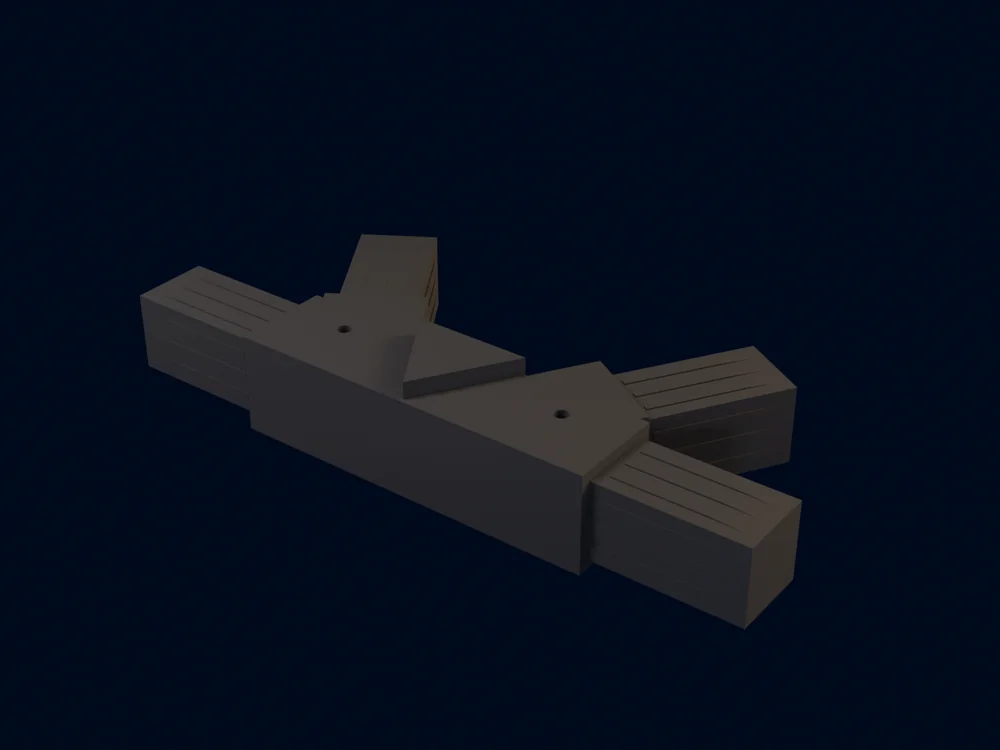
Where two panels meet tip to tip in the middle of a face. The 20 × 20 mm tube profile runs straight through, like welded tubes.
Alignment key fills the gap between the tips, 0.4 mm clearance
Variants A, B, C: same shape, different orientation on the face
05 / 10
Base joint
× 28
Bottom row of each face. Its underside is V-shaped, matching the bottom tubes, so it sits in the same V-cradle.
No base ring: the tubes keep their full profile
Nylon nut pockets underneath, hidden inside
06 / 10
Base corner
× 4
Joins the two bottom tubes and the hip tube at each corner.
Mitre-free: tubes are cut square
Sits in the corner cradle
07 / 10
Flush clamp
× 324
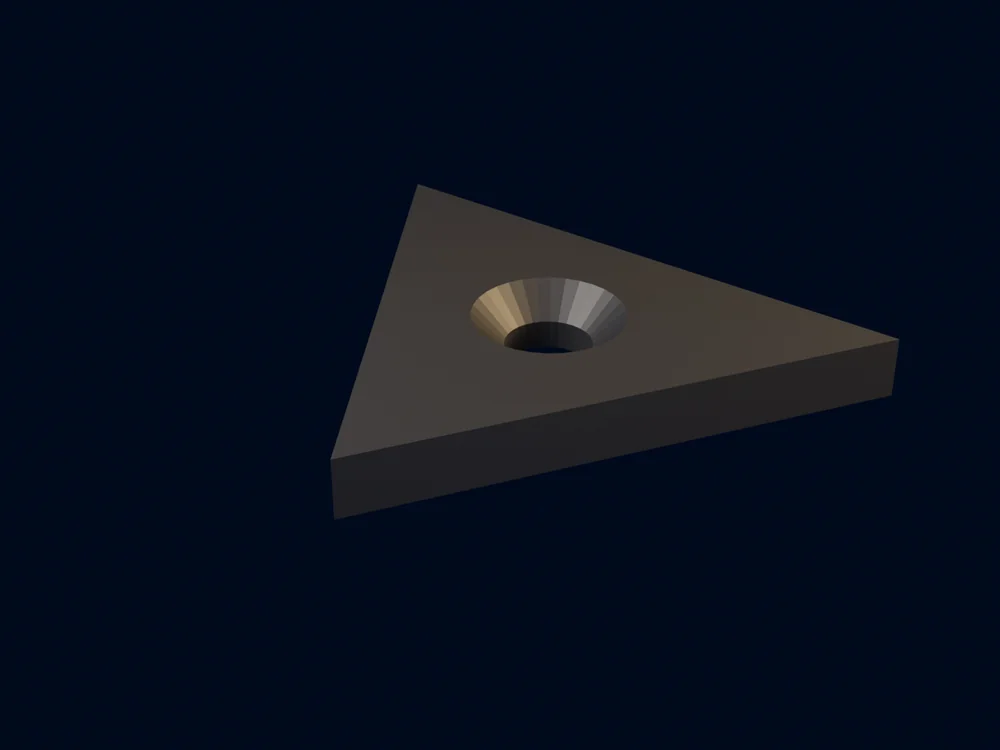
A 2 mm triangle that sits in a pocket of the black layer, flush with the copper, three per panel.
Countersunk M2.5 nylon screw
Nylon hex nut captured underneath: no metal except copper
08 / 10
Black printed layer
× 108 · 4 variants
3 mm ASA with the same fractal as the copper, so every hole goes right through. It carries the copper and stiffens the frame.
Pockets for the three clamps
Edges on the hips mitred so both faces meet cleanly
09 / 10
V-cradle
× 32 · 4 shapes, A / B
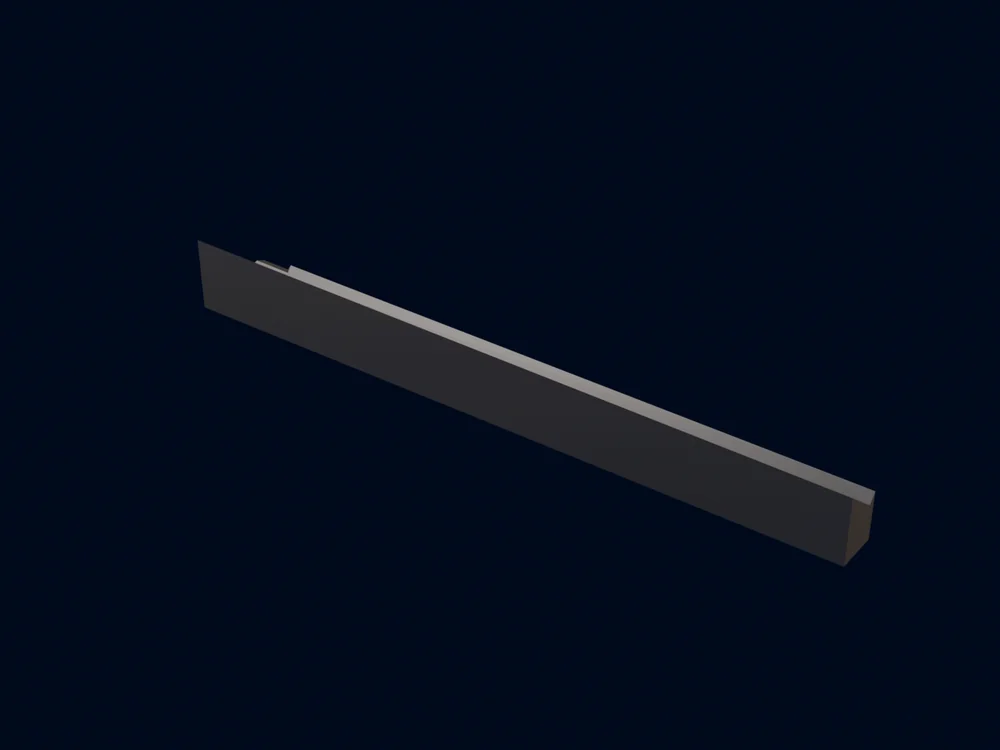
Tapered spacer under the bottom tubes from each corner towards the edge middle. The tube's corner sits in the V.
From about 25 mm under the tube at the corner down to about 3 mm
Locks the pyramid so it cannot slide
10 / 10
V-cradle cross-sections
drawing
The four cradle pieces in section, with the bottom tube resting in each V. All dimensions in millimetres.
22 mm wide, flat underside on the floor
Lip 6 mm up the tube's inner face
Every connector, clamp, layer and cradle is a 3D-printed ASA part. Images rendered from the actual print files. All joints share the same press-fit spigots: 30 mm into the tube, three 0.3 mm crush ribs on each face, no glue.
// 04 — Gallery
Renders, before the copper is cut.
Rendered in Blender from the full engineering model (every panel, tube, connector and clamp). The garden is a Poly Haven HDRI; the deck is Japanese cedar.
// 05 — The session
Bashar on the Great Pyramid, in copper.
This pyramid began with a question in a private session with Bashar on 18 August 2021, with Georgi and Krasimir. Below is the guidance at a glance, then the full conversation, exactly as transcribed.
Shape and proportions
Follow the proportions of the Great Pyramid, which is actually octahedral: each side bends in a little and is really two facets.
45:55 – 46:55
Fractal covering
Cover each side with a Sierpinski gasket. Not just a frame: air flows through and you can see through it.
45:31 – 45:55
Fractal levels
At least three, and more is fine. Six: “Yes.”
52:14 – 52:26
Material
Copper, for the best result. No pipes needed; Sierpinski triangles alone are even better.
46:55 – 47:52
Thickness
No thicker than a sixteenth of an inch, a little thinner if it will not bend.
52:28 – 52:48
Size and position
Big enough to sit in, at least six feet; eight is ideal. Sit in the centre in the lotus position.
48:04 – 50:14
The base
The bottom does not need Sierpinski triangles.
47:53 – 47:58
The top
Just the copper point. Later, optionally, a small gold pyramid of no more than about three inches.
52:48 – 53:16
The experience
It can centre you, and may help you become lucid in dreams and in physical reality.
48:15 – 49:05
The real test piece · photo
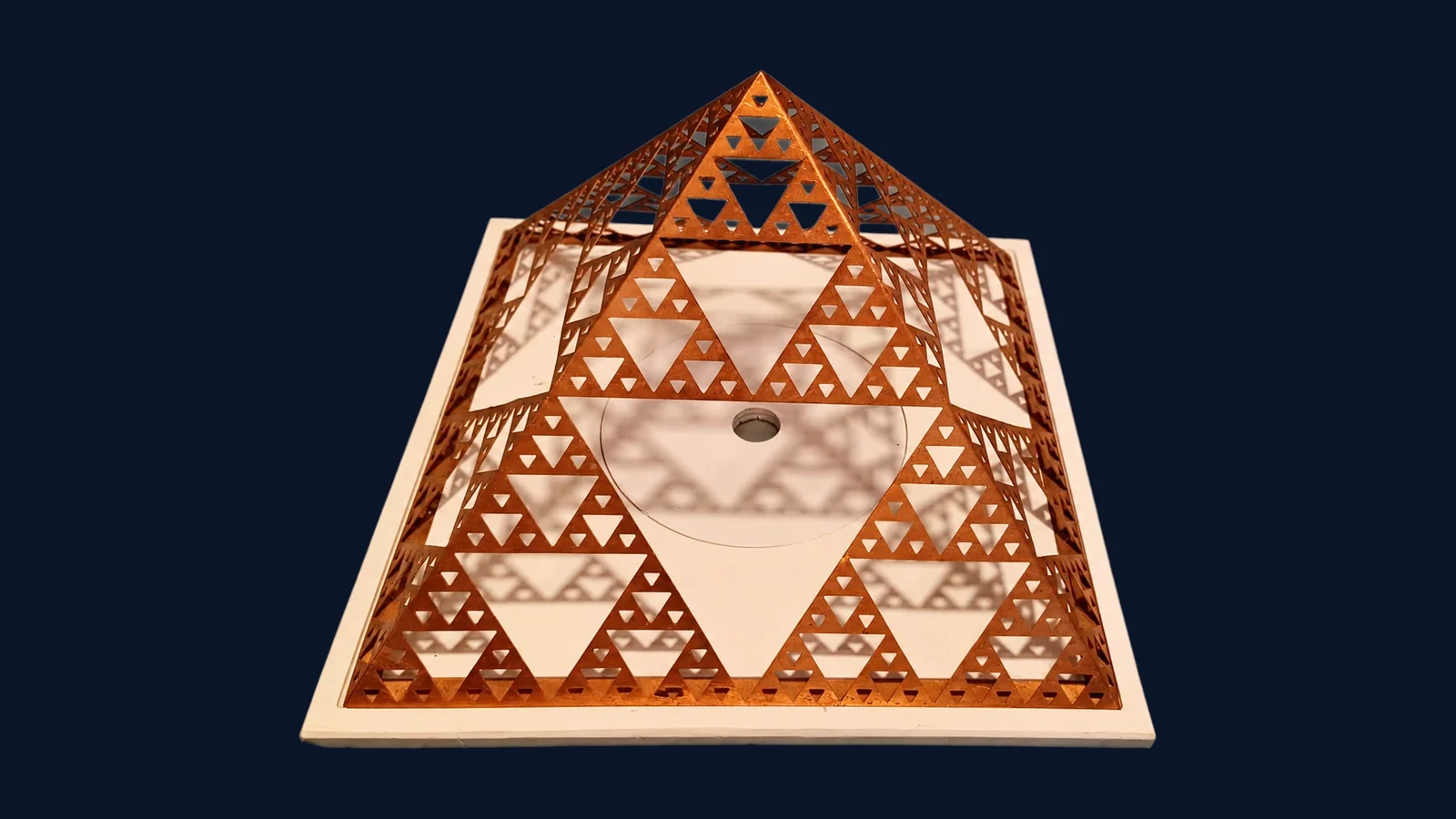
The pyramid I had in mind while speaking with Bashar.
My hand-sized copper test pyramid, made before the session. 49:07
Bashar, I would like to ask about, in generally, the structures, like pyramids, kind of structures. Let's say, if I make 12 feet pyramids, like the one in Giza, I make it from copper frame, from copper pipes. Is it going to have an effect if it's not covered, if it's just the structure, just the pipe frame, or it must be covered with non-insulating material or with copper? For example, what will be the difference if it's covered and if it's not covered?
Bashar
If it is covered with something similar, again, to a Sierpinski gasket, that would probably be the best of both worlds. Not just a frame, not just poles. It doesn't have to be solid, but it does have to be covered, and therefore, if you wish to still have airflow through it and be able to see through it to some degree, again, we would suggest that each side be a Sierpinski gasket. But the other thing to remember is that, while following the proportions of the Great Pyramid at Giza, you have to realize that it is actually octahedral.
Krasimir
Yes, yes, I know that.
Bashar
of each side actually bends in a little bit to the center. It's not perfectly straight. Each side is actually two facets that bend in very slightly. You can see this in the correct lighting of the Great Pyramid, that there's a line down the center that indicates that each of the four sides is actually two sides, so that the Great Pyramid actually has eight facets.
Krasimir
Yes, yes. I noticed this.
Bashar
All right. So if you make the Sierpinski gaskets bend in a little bit to mimic the exact proportions of the Great Pyramid, that would be the best thing to do in terms of copying the way the Great Pyramid lenses energy and focuses energy, as long as the proportions are accurate. But it must be conductive material again, copper, for the best. We would suggest it. It doesn't have to be different materials will give different effects, but for the idea that you're looking for, it would be best if it was copper.
Krasimir
Okay, and I would like to combine this idea with something else that you shared, with copper pipe, which inside have a pipe of steel. So, there is a pipe of steel, and outside of the pipe of steel, there is a copper pipe, and on the top of this, it's a crystal sphere.
Bashar
You don't need any of this. You don't need any of this.
Krasimir
Okay.
Bashar
Use copper pipe, use copper for the Sierpinski gasket sides. Let's start with that and see what happens.
Krasimir
Do you even need pipes if you can just have Sierpinski triangles?
Bashar
Even better. Even better.
Krasimir
Without pipes, it's even better, right?
Bashar
Yes.
Krasimir
And how about the bottom of the pyramid? Does it have to be covered with Sierpinski triangles?
Bashar
No. No, and 12 feet, it's quite big.
Krasimir
It's quite big. Maybe, if I make it, maybe six feet.
Bashar
Whatever you can fit in, and sit down in, yes.
Krasimir
And what is going to be the effect? Like, we're going to feel more conductive, receive information?
Bashar
Yes, it can center you in that way. You may even find that it helps pump you to the idea of expanding your consciousness to the point, where you may find it easier to become lucid in your dreams, lucid in physical reality, and maybe even experience out-of-body travel. It depends.
Krasimir
Like the coffer inside the king's chamber that you're talking about.
Bashar
Yes. But you don't necessarily need the coffer, depending upon how receptive you are to the vibrational bending of electromagnetic energy that the copper pyramid will create.
Krasimir
You mean it's not necessary to be from copper, can be something else?
Bashar
No, no, no, no. No, what I'm saying is, you may not need the coffer.
Krasimir
Ah, the coffer. Okay.
Bashar
Not for this size.
Krasimir
Yeah. I already made this pyramid from copper material, but it's much smaller. It's like a few inches. It's like...
Bashar
All right, well, so you have a test piece.
Krasimir
But I cannot fit in. I can hold it in my hand.
Bashar
Yes, I understand, but that's a totally different idea.
Krasimir
And what would be the ideal dimensions for a human being to be inside?
Bashar
At least six feet tall.
Krasimir
At least. Oh.
Bashar
Because something that you can sit in.
Krasimir
And what is the ideal position to sit in?
Bashar
In the center. In a meditative position.
Krasimir
In a meditative position.
Bashar
In the lotus position.
Krasimir
Lotus position. Okay.
Bashar
However, if it's possible for you to make it eight feet tall, that would be ideal.
Krasimir
Eight feet tall.
Bashar
This will be 13 feet sides. The sides, they will be 13 feet, approximately. That would be ideal for what you're talking about.
[ … ]
Krasimir
I find out that if it's 12 feet the sides of the pyramid, and that's then inside the square, the base, it's exactly 13 square meters.
Bashar
All right.
Krasimir
Which is our number. This is also Fibonacci number.
Bashar
Yes. Again, we will leave this up to you to experiment with, to see what effects it has on you when you meditate inside of it.
Krasimir
Okay.
[ … ]
Krasimir
And how many levels of Syrapensky [Sierpinski] triangles should there be ideally?
Bashar
At least three, but there can be more.
Krasimir
If we go up to six, would that be okay?
Bashar
Yes.
Krasimir
And how thick should be the copper sheet?
Bashar
Well, again, let's say no thicker than a sixteenth of an inch at that scale.
Krasimir
Okay.
Bashar
It can be a little thinner as long as you feel like it will not bend or deform.
Krasimir
Should there be anything on top? No apex?
Bashar
The point, just the point. Now, later if you wish, you can add, if you're capable of doing so, a very small, maybe no more than about, well, certainly no more than about three inches of a gold pyramid to complete it. You can do that, and it will have a slightly different effect, but it's not absolutely necessary for what you're seeking to do. So, just going to a copper point is fine.
Krasimir
Okay.
The summaries above are in our own words; the conversation is exactly as transcribed. The recording has no speaker names: “Krasimir” and “Bashar” were added from context, so a few short replies may be attributed wrongly. One word is clearly mis-transcribed (“Syrapensky”, for Sierpinski) and is marked in brackets. Bashar is channelled by Darryl Anka (bashar.org).
A documentary we recommend: Veli Martin Keitel's careful walk through the numbers built into the Great Pyramid, with clear animations.
Documentary · 35 min · Veli Martin Keitel
“The stunning geometry of Great Pyramid – full documentary” by Veli Martin Keitel, Meaning and Mystery Today (YouTube).
A few of the findings, in short
Height : width
280 : 440 royal cubits = 14 : 22. With π ≈ 22/7 the base is π/2 × the height. Our pyramid uses this exactly.
Slope and golden ratio
Faces at 51.84°. Slope height ÷ half the base = φ, the golden ratio.
Squaring the circle
Seen along the diagonal, height to half-diagonal is 9 : 10, the classic construction for a square and a circle of equal perimeter. It gives π and √2 to about 99.99% (311/99 and 140/99).
The royal cubit
The cubit the pyramid defines is 0.5236 m, which is π/6. The pyramid stands at almost exactly 30° north.
The King's Chamber
Its floor lies at the height where the pyramid's cross-section is exactly half the base area, and the chamber holds a 3-4-5 triangle.
// 07 — Sound and intention
A permission slip, tuned.
Bashar teaches that experience is what is real, and that tools and rituals are permission slips: things that give us permission to shift into a different experience. The ultimate permission slip is always our own choice. This pyramid is one such tool.
Bashar describes C♯, or a tone slightly above it, as the tonal vibration of the Earth. Immersing yourself in it, he says, can help amplify any other permission slip, tool or ritual, which is why we pair it with this pyramid. A sound system for the meditation space is planned. Listen to him explain it below.
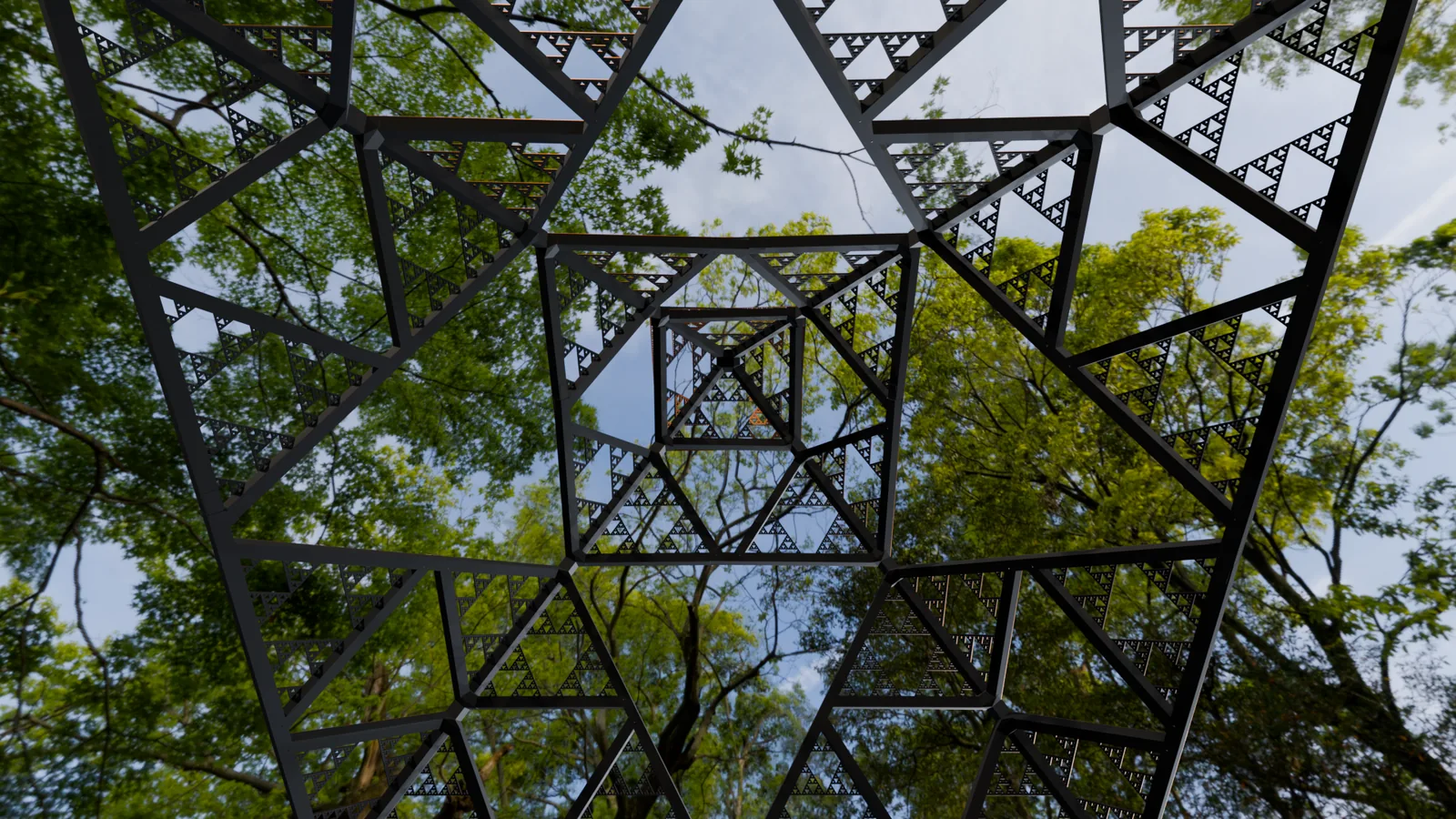
The view from the centre, where you sit.
Bashar on C♯ · the tone of the Earth · 2:01
0:002:01
Read the transcript
Many individuals have asked the question over and over, what is the tonal vibration of the earth?
C-sharp.
So, anyone who wants to explore the idea of playing with C-sharp, and in fact it's actually just slightly above C-sharp,
but anyone who wants to play with that tonally, with any of the other tools we have also used,
you will find that by allowing yourself to resonate within a bubble of noise, if you wish, music, if you wish, vibration, if you wish, of C-sharp,
it will allow you to identify, resonate harmoniously with the earth vibration, and that can really help amplify any other thing you do,
any other permission slip, any other tool technique that you wish to undertake, any other ritual, anything even that you wish to read,
if you will have, and it doesn't have to be loud, if you will immerse yourself in the tone of C-sharp,
you will find that clarity, clarity will begin to really come in.
You will literally begin to see sharp more things.
So, the earth itself, the earth vibration will support you, will back you up, will give you momentum,
and allow you to feel again that things are becoming more effortless, more easy,
for you will be really tapping into the power of the entire planet that way, the planet itself, that way.
And it will support you as it supports everything in nature.
Now, playing C-sharp, also in certain locations, through certain devices amplified in certain ways,
can also actually help realign and clarify some of what you would call your environmental pollution problems.
Audio: Bashar, channelled by Darryl Anka · bashar.org. Excerpt shared with credit; transcript generated from the recording.
C♯4 277.2 Hz
+0 cents · use headphones, low volume
// 08 — Status
From a session to a structure.
August 2021Private session with Bashar: proportions, eight facets, Sierpinski copper, size and position.
A few inchesA small copper test pyramid, held in the hand.
October 2026Full 3D engineering model: 108 identical panels, the φ² fold, 133 connectors, V-cradles. Print files and copper cutting files ready, first quotes received.
NextTest panels and connectors, then the first full face.
ThenThe full pyramid, meditation inside, and sound.