All physical phenomena arise from the interaction of two fundamental, co-existing continuums.
They never fuse, but always stand side by side — each defining the other through equal and
opposite action. Every force, every material, every circuit in nature is a specific expression
of their relationship.
S FIELD — SPACE FIELD
Kinetic, expanding continuum
Forms the sphere
Radiates outward from center
Expression of dynamic pressure and motion
Accelerates to the sphere boundary
T FIELD — TIME FIELD
Potential, contracting continuum
Forms the point (center)
Travels inward as a line to center
Expression of stored potential and tension
Decelerates toward the center point
The two fields form a closed circuit: S Field radiates outward from the T Field center, expands
to the sphere boundary, reaches the Point of Change = 0, converts back to T Field, and
returns inward as a line. This cycle is the base unit of all field activity.
PRIMARY LAW
The Law of Equilibrium
The Law of Equilibrium is an omnipresent force operating continuously across all field circuits.
Its governing action: greater potential always flows toward lesser potential, mediated by
an invisible balance point — the fulcrum. It does not merely determine the direction of flow —
it governs the speed and geometry of all field motion through the S/T ratio: the ratio
of space traversed to time taken in any field action.
"The Law of Equilibrium always establishes an invisible point fulcrum on a line of economy
between two potential points. Should it happen that potential point A and B are not equal,
parts of the greater point A will travel to the smaller point B by way of that point fulcrum,
in order to create a balance. The space over which potential ST Field energy travels from point A
to point B is critical to the speed and balance of that movement."
— Field Physics Reference
Momentum and inertia are not independent principles — they are extensions of the Law of
Equilibrium, operating as its sustained expressions within a field circuit. The law also encodes
a principle of energy gain through circulation: potential spent outward returns to
center with interest, creating new energy through the cycle rather than merely conserving it.
CONVENTIONAL BRIDGE
The closest equivalent in conventional physics is the Principle of Least Action — systems
evolve along paths that minimize action. Fermat's Principle in optics, geodesics in General
Relativity, and thermodynamic equilibration all reflect this same tendency. The S/T ratio maps
structurally to the space-time relationship in relativistic mechanics.
THE BALANCING MECHANISM
The Point Fulcrum
The point fulcrum is the invisible balance point established on the line of economy between any
two potential points. It is not a passive null zone — it is an active power center that stimulates
motion in field circuitry:
"What is this mysterious invisible point fulcrum all about, since it always appears in any
struggle to balance? It is a point upon an axis that is multiplied everywhere. IT IS POWER.
It is a flexible power that stimulates a motion in field circuitry. It manifests as an equality
in the ratio between time and space. It sets up cosmic highways of communication."
— Field Physics Reference
The interactive model below demonstrates the four primary expressions of the Law of Equilibrium
and the Point Fulcrum in field circuit behavior. Use the controls to explore each mode.
INTERACTIVE FIELD CIRCUIT SIMULATOR
LAW OF EQUILIBRIUM
BASIC CIRCUIT FLOW
FLOW — POTENTIAL & KINETIC
Equal potentials = EQUILIBRIUM. Potential (blue) flows inward from both ends. Kinetic (red) radiates outward from centre in both directions. Tip one slider to begin directional flow.
CONTROLS
Potential A50
Potential B50
Potential — blue (cold)
Kinetic — red (hot)
State
EQUILIBRIUM
Flow Rate
0 u/s
Fulcrum
Fixed at centre
Potential A70
Potential B30
Potential — blue
Kinetic — red
Fulcrum
—
Lever Arms
—
Principle
P(a) × arm(a) = P(b) × arm(b)
Potential A50
Potential B50
Ring Count8
Speed1.0
Pattern
Vesica Piscis
Nodes
—
Speed1.0
Potential — blue
Kinetic — red
FOUR KEY FEATURES
Expressions of the Point Fulcrum
01
LINE OF ECONOMY
The direct path between two potential points where equilibrium is sought. Energy travels
along this line from greater to lesser potential. The space traversed and the
time taken define the S/T ratio — the speed and geometric balance of all field motion.
CLOSURE acts along this line like a stretched rubber band: at every point between the two
potentials, an undertoned fulcrum pulls inward, maintaining the tension that prevents all
potentials from collapsing together.
STRONG BRIDGE— Principle of Least Action / Potential Gradient
02
VORTICAL FORM
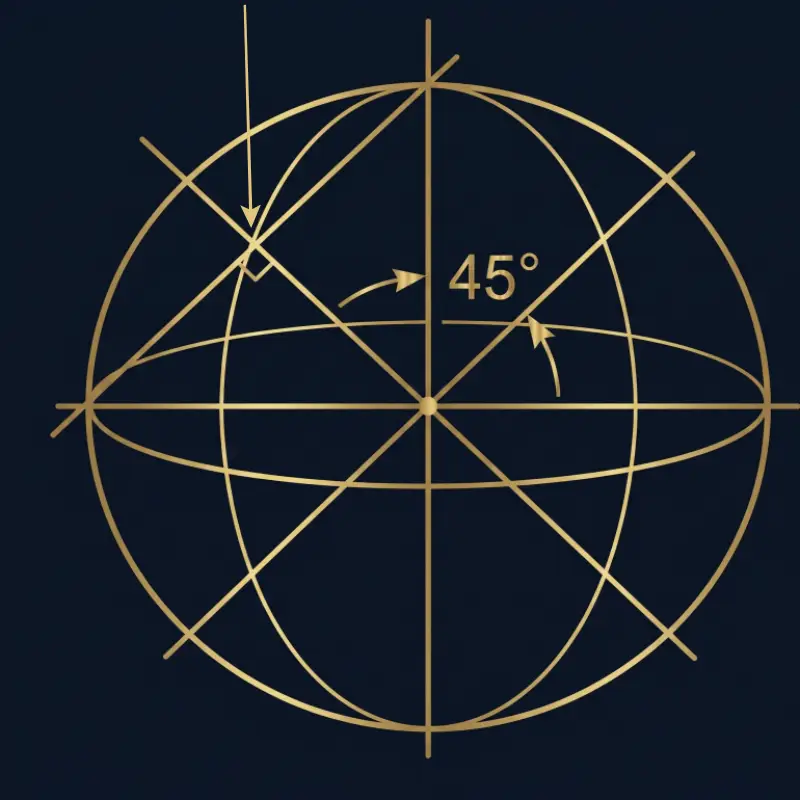
The equilibrium axis does not appear arbitrarily. It is a consequence of geometry.
Where the Primary Vertical Axis meets the boundary, it creates a potential point.
Where the Secondary Horizontal Axis meets the boundary, it creates a second potential
point. The Law of Equilibrium activates between these two boundary points — establishing a
Line of Economy between them. The Point Fulcrum sits at the exact center,
equidistant from both.
The equilibrium axis passes through that fulcrum at 45° — not by design, but by
geometric necessity. It is the only line that bisects the angle between the Primary Vertical
and Secondary Horizontal axes equally. This is the place where both axes are in precise
balance.
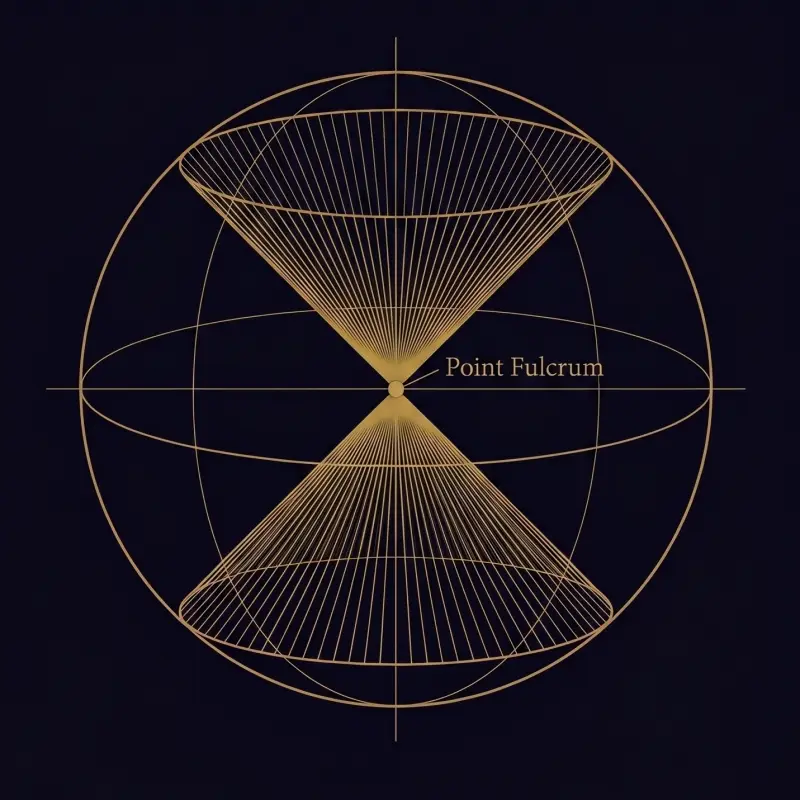
Because the sphere is a closed form, this relationship repeats continuously around the center
point. The equilibrium axis multiplied around the Primary Vertical Axis produces the
double-cone vortical form — two cones converging at the Point Fulcrum, one above and
one below the equatorial plane.
Primary & Secondary axes — Line of Economy — Point Fulcrum at 45°Equilibrium axis multiplied → double-cone vortical form
PARTIAL BRIDGE— Double-cone geometry confirmed in plasma physics, magnetic dipoles, astrophysical jets
RESEARCH OBSERVATION — INTERPRETIVE · NOT YET EXPERIMENTALLY VERIFIED
The top cone rotates clockwise seen from above; the bottom cone rotates clockwise seen from below — making them counter-rotating relative to each other in absolute space. Applying the right-hand rule to both: the top cone directs field lines downward toward center; the bottom cone directs field lines upward toward center. Both vectors point simultaneously inward to the Point Fulcrum.
This suggests the double-cone vortical form is not merely a geometric expression of equilibrium — it is an active inward pump, continuously concentrating potential at the center point from both directions. This is consistent with the source description of T Field concentrating toward the fulcrum from both potential boundary points under the Law of Equilibrium.
03
COMMON AXIAL LINE
When two equal and opposite field spheres recognize an equilibrium harmony, a new common
axial line forms center-to-center. This initiates CLOSURE — the spheres draw together,
surface tensions touch, and a common circular chord forms between them.
The chord is layered: S Field predominant on one side, T Field predominant on the other,
with a universal field axis through the center. A torus forms around the chord — the plane
where field circuitry seeds new structure.
Circular energy rings that always form around a point fulcrum, in direct ratio to
its energy. They form around every motion, force, and form — both mechanical and electrical,
the equal and opposite complement to T Field linear activity.
Under pressure, tori undertone instantly into harmonic subdivisions. This is experimentally
confirmed by cymatics research: amplitude increase produces abrupt, precise harmonic
reorganization of field geometry, with subdivision count in direct ratio to the added potential.
The following maps each feature to its closest equivalent in conventional physics,
confirms where current science agrees, and identifies where the gap remains open.
Feature
Conventional Equivalent
Open Gap
Bridge
Line of Economy
Principle of Least Action; potential gradients; geodesics in GR
No universal inward CLOSURE force through vacuum
STRONG
Vortical Form
Double-cone geometry in plasma, magnetic dipoles, astrophysical jets
45° equilibrium-axis derivation has no equivalent in field theory
Field recognition harmony; seeded materialization on a common chord
PARTIAL
Tori
Lenz's Law; toroidal EM fields; tokamak confinement; vortex rings
No unified ontology linking all forces into one toroidal principle
STRONG
NOTE ON BRIDGE RATINGS
Strong = behavior well-confirmed by conventional physics. Partial = geometry or effect confirmed,
underlying mechanism differs. Open gaps mark the active research frontier.
CIRCUIT SUMMARY
The Complete ST Circuit
The Law of Equilibrium and the Point Fulcrum together define the complete field circuit —
the base unit of all field activity:
T Field potential stores at center
→
Law of Equilibrium activates
→Point Fulcrum establishes on Line of Economy
→S Field radiates outward
→
Tori form around all motion
→
S Field reaches sphere boundary
→Point of Change = 0→
S Field converts to T Field→
Returns inward to center
→
Circuit completes
Every physical phenomenon — gravity, magnetism, electricity, material accretion, harmonic
resonance — is a specific expression of this circuit operating at a particular scale of
field activity.
RESEARCH IDENTITY
References & Attribution
DOCUMENTATION
Kolev, K. (2024–2025). Symmetric Field Physics — Independent Research Documentation. Allistar Center. ORCID: 0009-0007-4394-8722
Jenny, H. (1967). Cymatics: A Study of Wave Phenomena and Vibration. Basilius Presse. — Experimental basis for harmonic subdivision under pressure (Tori, Feature 04).
Feynman, R., Leighton, R., Sands, M. (1964). The Feynman Lectures on Physics. Addison-Wesley. — Least Action principle, electromagnetic field theory.
Misner, C., Thorne, K., Wheeler, J. (1973). Gravitation. W. H. Freeman. — Geodesics, spacetime geometry (Line of Economy bridge).
SYMMETRIC FIELD PHYSICS — ALLISTAR CENTER — INDEPENDENT RESEARCH DOCUMENTATION